
Sweetness is not luck. It is a controlled variable.
Every Seolhan greenhouse zone runs on a closed loop: sense, decide, actuate, log. The same data that keeps the plants comfortable also tells us how much fruit we can safely sell — which is why our pre-order windows never oversell.
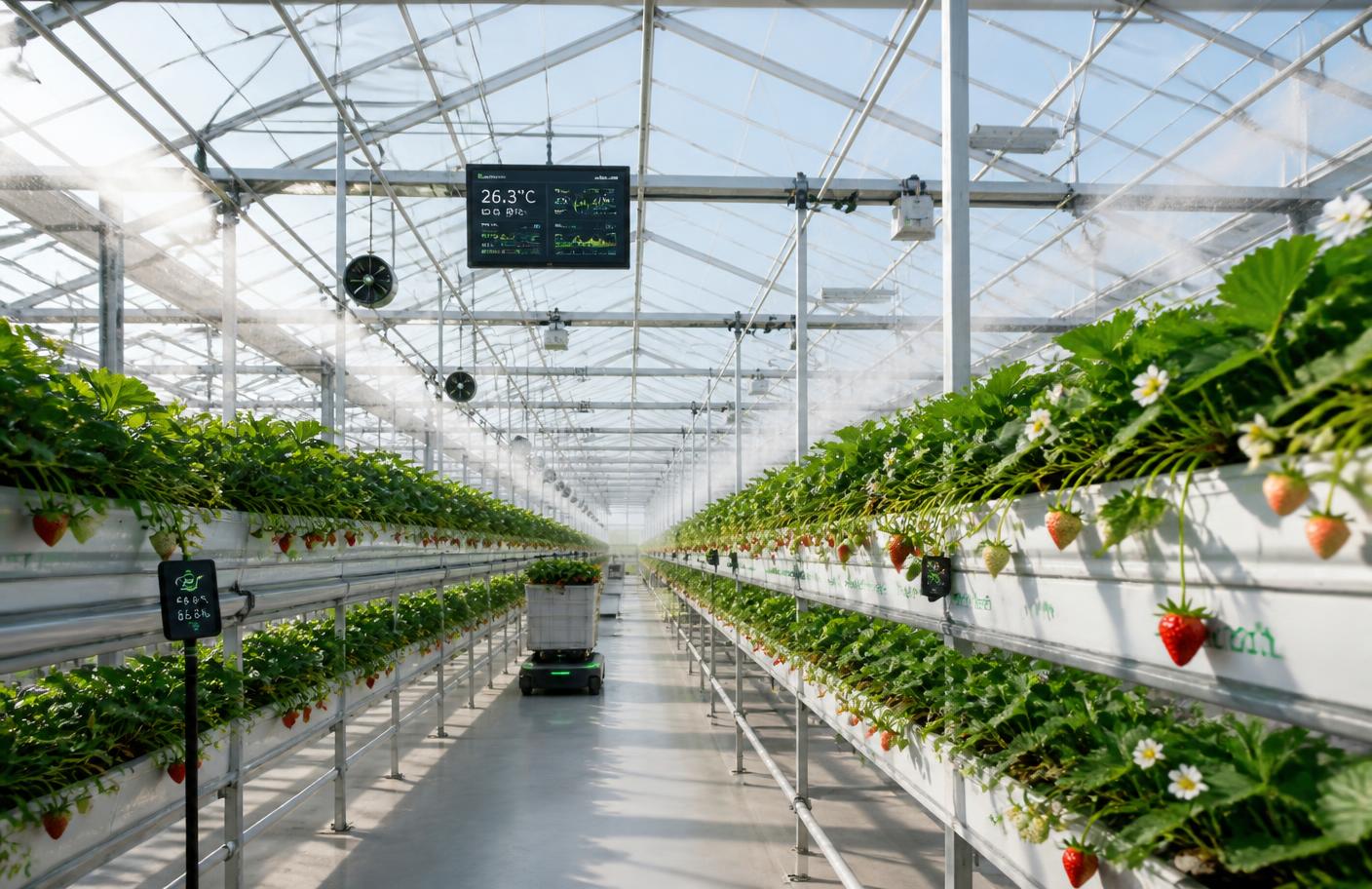
Live zone readings · sample view
Greenhouse floor, right now.
| Zone | Air temp | Humidity | CO₂ | Feed EC | Feed pH | Stage |
|---|---|---|---|---|---|---|
| Zone A · Seolhyang | 21.4°C | 72% | 912 ppm | 1.42 | 5.9 | Fruiting |
| Zone B · Seolhyang | 20.9°C | 70% | 884 ppm | 1.51 | 6.0 | Ripening |
| Zone C · Kingsberry | 22.1°C | 68% | 935 ppm | 1.30 | 5.8 | Flowering |
| Zone D · Maehyang | 21.0°C | 74% | 901 ppm | 1.38 | 5.9 | Fruiting |
Illustrative readings shown for the pilot house. Live telemetry streaming will replace this table once the sensor gateway is commissioned.
What we measure and control.
Environmental sensing
- Air temperature and relative humidity, 4 heights per zone
- Infra-red leaf temperature for real transpiration load
- PAR and DLI accumulation with supplemental LED top-up
- CO₂ enrichment held at 800–1,000 ppm during photoperiod
- Vapour pressure deficit as the master control variable
Water quality
- Source water: turbidity, hardness, alkalinity, heavy metals (quarterly lab)
- Inline pH, EC, ORP, dissolved oxygen and temperature
- UV sterilisation plus 5-micron filtration before every dosing cycle
- Drain-water EC and drain-% logged per irrigation event
- Closed-loop recapture with automatic top-up correction
Nutrition formula
- Two-tank A/B dosing with per-zone recipe profiles
- Stage-based EC ramp: 1.1 vegetative → 1.6 pre-harvest
- K:Ca:Mg tuned for firmness, shelf life and sugar loading
- Weekly leaf-tissue and substrate analysis feeding recipe updates
- Every recipe change versioned against Brix outcomes
Control & alerting
- Automated cooling, fogging, screens, vents and irrigation valves
- Fail-safe fallback rules if any sensor drops out
- SMS and app alerts on out-of-band readings within 60 seconds
- Backup generator and UPS on all climate-critical circuits
- Full audit trail per batch, exportable for GAP certification
The sweetness protocol
Six levers between a good berry and a great one.
Night temperature
10–12°C
Slows respiration so the plant banks sugar overnight
Pre-harvest EC
1.5–1.6 mS/cm
Mild osmotic stress concentrates soluble solids
Controlled deficit
−15% volume, 7 days
Less dilution, denser flavour, firmer flesh
CO₂ enrichment
800–1,000 ppm
More photosynthate available for the fruit
Harvest colour
100% red, no shoulders
Strawberries do not ripen after picking
Field to 2°C
Under 120 minutes
Locks in aroma volatiles and shelf life